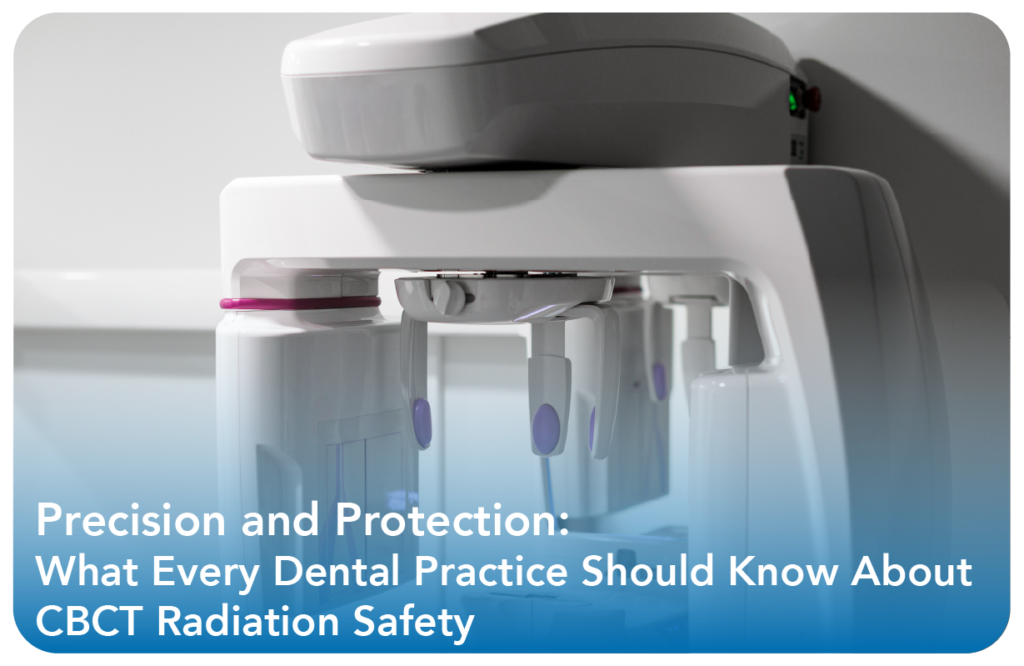
Precision and Protection: What Every Dental Practice Should Know About CBCT Radiation Safety
Cone-Beam Computed Tomography (CBCT) has quietly transformed modern dentistry. What was once a specialized imaging tool reserved for complex cases is now a routine part of implant planning, pediatric care, and treatment for patients with special needs. Where dentists once relied on flat, two-dimensional X-rays, they can now see teeth, nerves, and sinuses in full three-dimensional detail. A shift that has made procedures safer, more precise, and more predictable.
As CBCT use has grown, so has the need for practices to understand exactly how much radiation these scans deliver, where that radiation goes, and how to keep both patients and staff as safe as possible.
This article is based on content from a recent webinar featuring West Physics’ own Vinobalan “Vino” Durairaj, Ph.D, DABR. This article offers a useful blueprint for any practice looking to modernize its approach to radiation safety.
Putting CBCT Dose in Context
One of the biggest challenges in radiation safety is communication. Numbers like “microsieverts” mean little to most patients, so context matters. Here’s how the major dental imaging modalities stack up:
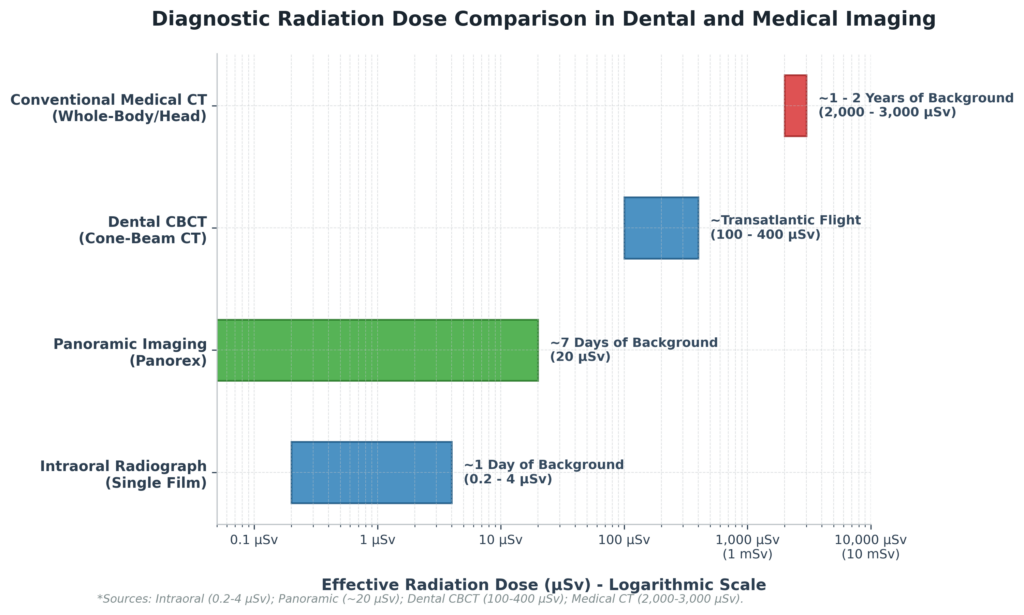
- Intraoral X-rays deliver the smallest dose of all, roughly equivalent to a single day’s worth of natural background radiation.
- Panoramic scans step that up slightly, delivering about the same exposure as a few days of background radiation.
- CBCT scans typically fall in the range of 100–400 microsieverts, comparable to about ten days of natural background exposure.
- Medical CT scans, by contrast, are dramatically higher, often 1 to 2 years’ worth of background radiation in a single exam.
A particularly useful analogy for patients: a dental CBCT scan delivers roughly the same radiation dose as a transatlantic flight. The key difference, of course, is that a dental scan comes with a direct diagnostic benefit, while a flight does not.
The “It’s Low Dose, So It’s Fine” Trap
Because CBCT doses are so much lower than medical CT, it’s tempting for practices to treat them casually. The experts caution against this. Two factors make CBCT worth taking seriously even at lower doses.
First, frequency. Patients undergo dental imaging far more often over a lifetime than they undergo medical CT scans, and small repeated exposures can add up over time. Even the slightest increase in risk gets accumulated quickly.
Second, geometry. Medical CT spreads its dose across a broad area of the body. Dental CBCT, by comparison, concentrates a narrow beam into a small zone, meaning nearby sensitive structures like the thyroid, salivary glands, pituitary gland, and breast tissue can receive a disproportionately concentrated dose. That’s precisely why thoughtful shielding and protocol selection matter so much.
What Actually Drives Radiation Dose
Not all CBCT scans are created equal. Dose varies significantly based on a handful of controllable factors:
- Field of view. Scanning a larger volume than necessary is one of the most common sources of excess dose. The rule of thumb: capture only the region actually needed.
- Voxel resolution. Higher-resolution scans, useful for things like root canal evaluation, require more photons and therefore more dose.
- Technical settings like mA, kVp, and exposure time directly scale with radiation output.
- Patient motion, which forces a repeat scan and effectively doubles exposure in an instant.
Interestingly, one of the more overlooked contributors to unnecessary dose is historical: many practices that transitioned from film to digital sensors never recalibrated their equipment settings. They kept running film-era mA and kVp levels on digital systems, missing out entirely on the dose-reduction benefits digital technology was designed to offer. Optimizing a protocol to fit the patients’ needs/diagnosis should take the center stage, however, a lot of the imaging facilities overlook this important step falling for the ‘low dose in Dental CBCT’ conundrum. OEM oriented differences in protocol implementation for different procedures aggravates this challenge even further.
The Shielding Debate
Lead aprons and thyroid shields remain a genuinely contested topic in radiology. Shielding is required for pregnant patients and mandated in several states, but it isn’t a simple “more is always better” situation. If a shield drifts even slightly into the scanner’s field of view, it can create artifacts or block anatomy the clinician needs to see — forcing a repeat scan and, ironically, doubling the patient’s radiation exposure. The takeaway: Patient shielding could be valuable, but only when positioned with precision.
Practicing ALARA the Right Way
The guiding principle behind dose optimization is ALARA (As Low As Reasonably Achievable). Importantly, this doesn’t mean “always use the lowest possible setting.” Sometimes a physicist will actually recommend increasing technical parameters to ensure an image is diagnostically useful. True optimization balances dose against image quality, not one at the expense of the other. Achieving diagnostic image quality in the acquired images is the best way to keep the dose optimal, as it would reduce the number of repeat scans.
Five habits help practices strike that balance:
- Positioning patients perfectly to avoid repeat scans
- Standardizing protocols based on clinical indication rather than personal preference
- Adapting to dedicated settings/protocols for scanning pediatric patients
- Completing third-party acceptance testing and annual physics surveys to assess radiation output and image quality
- Performing consistent preventative maintenance to catch equipment drift before it affects patient scans

Staff Safety: From Compliance Chore to Quality Signal
Patient safety is only half the equation. Many practices treat staff dosimetry badges as paperwork or see it as a quarterly report to file and forget. This mindset needs to change. Dosimetry data is a live signal of how a practice is actually performing.
Typical occupational exposure for staff running intraoral and panoramic X-rays averages around 20 millirem per year, but CBCT introduces different scatter geometry that can push annual exposure higher depending on where staff stand during a scan. Federal rules require monitoring once a worker is expected to exceed 500 millirem annually (10% of the annual threshold), and any unexplained spike in a staff member’s dosimetry report, say, jumping from 20 to 100 millirem warrants immediate investigation.
Good habits to reduce staff dose include:
- Wearing badges at collar level outside protective gear (or at the waist, under lead, for pregnant staff)
- Setting a two-tier ALARA alert system so early warnings trigger review before levels become a real concern
- Utilize safety barriers by always standing behind a wall or door during patient exposures
Building a Culture, Not Just a Checklist
Radiation safety works best as a team effort with dentists, technologists, physicists, and administrators all sharing responsibility. Education is key in building a robust safety culture in radiation environments and physicists play a vital role in helping facilities implement safety initiatives. Practices without an in-house physicist can still meet this standard by designating a Radiation Safety Officer to oversee protocols, run internal audits, and coordinate ongoing training.
For practices ready to formalize their commitment, third-party accreditation offers independent verification of equipment performance and clinical protocols. Done well, radiation safety stops being a regulatory hurdle and becomes what it should be: a core part of delivering precise, trustworthy dental care.
Have questions or need more information how you can set your CBCT unit and facility up for success? Our board-certified medical physicists help facilities build compliant QA/QC programs, complete the required testing, identify gaps, and get you accreditation-ready.
Call us today and we will answer any questions you may have!
Blog Form Survey Meter Calibration Service