Request a quote * = required field Cancel

Please fill out the form below to have a West Physics representative contact you to arrange for a service or product quote for your facility.

Our address and telephone numbers are:

West Physics
3825 Paces Walk SE
Suite 250
Atlanta, GA 30339

770-435-9186 • 1-866-275-9378 • FAX 770-599-2333

Office Hours: West Physics maintains liberal office hours for the convenience of our customers nationwide.

Monday-Friday:

9AM – 8PM Eastern Time
8AM – 7PM Central Time
7AM – 6PM Mountain Time
6AM – 5PM Pacific Time

Closed Weekends & U.S. National Holidays

Request a quote

Blog

Precision and Protection: What Every Dental Practice Should Know About CBCT Radiation Safety
Cone-Beam Computed Tomography (CBCT) has quietly transformed modern dentistry. What was once a specialized imaging tool reserved for complex cases is now a routine part of implant planning, pediatric care, and treatment for patients with special needs. Where dentists once relied on flat, two-dimensional X-rays, they can now see teeth, nerves, and sinuses in full three-dimensional detail. A shift that has made procedures safer, more precise, and more predictable.

As CBCT use has grown, so has the need for practices to understand exactly how much radiation these scans deliver, where that radiation goes, and how to keep both patients and staff as safe as possible.

This article is based on content from a recent webinar featuring West Physics’ own Vinobalan “Vino” Durairaj, Ph.D, DABR. This article offers a useful blueprint for any practice looking to modernize its approach to radiation safety.

Putting CBCT Dose in Context

One of the biggest challenges in radiation safety is communication. Numbers like “microsieverts” mean little to most patients, so context matters. Here’s how the major dental imaging modalities stack up: 
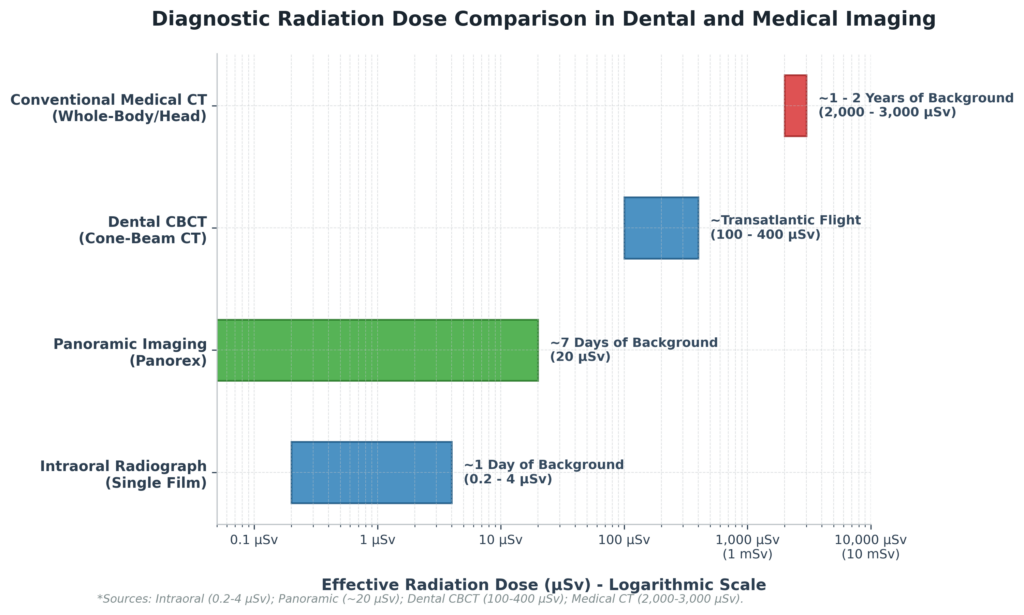
  • Intraoral X-rays deliver the smallest dose of all, roughly equivalent to a single day’s worth of natural background radiation.
  • Panoramic scans step that up slightly, delivering about the same exposure as a few days of background radiation.
  • CBCT scans typically fall in the range of 100–400 microsieverts, comparable to about ten days of natural background exposure.
  • Medical CT scans, by contrast, are dramatically higher, often 1 to 2 years’ worth of background radiation in a single exam.

A particularly useful analogy for patients: a dental CBCT scan delivers roughly the same radiation dose as a transatlantic flight. The key difference, of course, is that a dental scan comes with a direct diagnostic benefit, while a flight does not.

The “It’s Low Dose, So It’s Fine” Trap

Because CBCT doses are so much lower than medical CT, it’s tempting for practices to treat them casually. The experts caution against this. Two factors make CBCT worth taking seriously even at lower doses.

First, frequency. Patients undergo dental imaging far more often over a lifetime than they undergo medical CT scans, and small repeated exposures can add up over time. Even the slightest increase in risk gets accumulated quickly.

Second, geometry. Medical CT spreads its dose across a broad area of the body. Dental CBCT, by comparison, concentrates a narrow beam into a small zone, meaning nearby sensitive structures like the thyroid, salivary glands, pituitary gland, and breast tissue can receive a disproportionately concentrated dose. That’s precisely why thoughtful shielding and protocol selection matter so much.
What Actually Drives Radiation Dose

Not all CBCT scans are created equal. Dose varies significantly based on a handful of controllable factors:

  • Field of view. Scanning a larger volume than necessary is one of the most common sources of excess dose. The rule of thumb: capture only the region actually needed.
  • Voxel resolution. Higher-resolution scans, useful for things like root canal evaluation, require more photons and therefore more dose.
  • Technical settings like mA, kVp, and exposure time directly scale with radiation output.
  • Patient motion, which forces a repeat scan and effectively doubles exposure in an instant.

Interestingly, one of the more overlooked contributors to unnecessary dose is historical: many practices that transitioned from film to digital sensors never recalibrated their equipment settings. They kept running film-era mA and kVp levels on digital systems, missing out entirely on the dose-reduction benefits digital technology was designed to offer. Optimizing a protocol to fit the patients’ needs/diagnosis should take the center stage, however, a lot of the imaging facilities overlook this important step falling for the ‘low dose in Dental CBCT’ conundrum. OEM oriented differences in protocol implementation for different procedures aggravates this challenge even further. 

The Shielding Debate

Lead aprons and thyroid shields remain a genuinely contested topic in radiology. Shielding is required for pregnant patients and mandated in several states, but it isn’t a simple “more is always better” situation. If a shield drifts even slightly into the scanner’s field of view, it can create artifacts or block anatomy the clinician needs to see — forcing a repeat scan and, ironically, doubling the patient’s radiation exposure. The takeaway: Patient shielding could be valuable, but only when positioned with precision.

Practicing ALARA the Right Way

The guiding principle behind dose optimization is ALARA (As Low As Reasonably Achievable). Importantly, this doesn’t mean “always use the lowest possible setting.” Sometimes a physicist will actually recommend increasing technical parameters to ensure an image is diagnostically useful. True optimization balances dose against image quality, not one at the expense of the other. Achieving diagnostic image quality in the acquired images is the best way to keep the dose optimal, as it would reduce the number of repeat scans.

Five habits help practices strike that balance: 

  • Positioning patients perfectly to avoid repeat scans
  • Standardizing protocols based on clinical indication rather than personal preference
  • Adapting to dedicated settings/protocols for scanning pediatric patients
  • Completing third-party acceptance testing and annual physics surveys to assess radiation output and image quality
  • Performing consistent preventative maintenance to catch equipment drift before it affects patient scans

Staff Safety: From Compliance Chore to Quality Signal

Patient safety is only half the equation. Many practices treat staff dosimetry badges as paperwork or see it as a quarterly report to file and forget. This mindset needs to change. Dosimetry data is a live signal of how a practice is actually performing.

Typical occupational exposure for staff running intraoral and panoramic X-rays averages around 20 millirem per year, but CBCT introduces different scatter geometry that can push annual exposure higher depending on where staff stand during a scan. Federal rules require monitoring once a worker is expected to exceed 500 millirem annually (10% of the annual threshold), and any unexplained spike in a staff member’s dosimetry report, say, jumping from 20 to 100 millirem warrants immediate investigation.

Good habits to reduce staff dose include:

  • Wearing badges at collar level outside protective gear (or at the waist, under lead, for pregnant staff)
  • Setting a two-tier ALARA alert system so early warnings trigger review before levels become a real concern
  • Utilize safety barriers by always standing behind a wall or door during patient exposures

Building a Culture, Not Just a Checklist

Radiation safety works best as a team effort with dentists, technologists, physicists, and administrators all sharing responsibility. Education is key in building a robust safety culture in radiation environments and physicists play a vital role in helping facilities implement safety initiatives. Practices without an in-house physicist can still meet this standard by designating a Radiation Safety Officer to oversee protocols, run internal audits, and coordinate ongoing training.

For practices ready to formalize their commitment, third-party accreditation offers independent verification of equipment performance and clinical protocols. Done well, radiation safety stops being a regulatory hurdle and becomes what it should be: a core part of delivering precise, trustworthy dental care.

Have questions or need more information how you can set your CBCT unit and facility up for success? Our board-certified medical physicists help facilities build compliant QA/QC programs, complete the required testing, identify gaps, and get you accreditation-ready. 

Call us today and we will answer any questions you may have!

Blog Form Survey Meter Calibration Service
Email(Required)


Radiology Compliance: The Real Cost of Waiting Until There’s a Problem

If you manage or work in a radiology department, you already know compliance is far more than passing an inspection or checking boxes. Behind every requirement or regulation is a patient: someone’s parent, spouse, child, or loved one depending on the medical physicist getting it right the first time. Equipment performance, radiation safety, quality control and accreditation ultimately all come down to one thing: provide the highest quality care to patients.

Unfortunately, sometimes compliance can be reactive. 

Your annual physics survey is coming up, finally, someone starts to dig through all the records, paperwork, emails and files. Your accreditation renewal is due very soon, so the documentation scramble begins, or a CT tube gets replaced, and only then does someone ask, “so do we need extra testing for this?”. Now a state inspector has shown up, and suddenly everyone’s hunting for paperwork that should’ve been easy to find and quickly accessible

The thing is, by the time you are aware of a compliance issue, you’ve usually already missed your BEST chance to deal with it EASILY.

“Best” and “Easily” being the key words here. If only you would’ve caught it sooner. The shift from reacting to compliance issues to managing them proactively makes all the difference.

The Risk Hides Between The Deadlines

Most departments are great at the predictable and routine stuff. Physics evaluations get scheduled. Registrations get renewed. Accreditation deadlines are on the calendar. Routine QC happens like clockwork.

But the biggest risks often show up between those scheduled events, not during them.

If you think about the normal life of your imaging equipment: a CT tube gets swapped out, a detector fails, a fluoroscopy unit needs a major repair, you move a piece of equipment to a different room, or you renovate the space it’s in, new equipment comes online, software gets upgraded, or a major component gets replaced.

From a day-to-day operations view, these look like routine service events, but from a regulatory view, they can be a whole lot more than that.

Depending on the modality, the specific equipment change, your accreditation requirements, and the state you’re in, any of these events might trigger extra testing, updated registrations, additional surveys, required notifications, or other actions you weren’t necessarily thinking about.

This is exactly where a strong compliance program separate itself from the reactive ones, because a strong compliance program is tracking events, not just dates on a calendar.

Equipment Changes Are Your Biggest Blind Spot

Ask yourself: what actually happens when something changes with your imaging equipment?

When there’s a major repair or a component gets replaced, is there a clear process for figuring out whether that triggers additional testing or regulatory action? That process usually touches several people, like the field service engineer, medical physicist, your Radiation Safety Officer, imaging leadership, and maybe others.

The problem is that these folks often work in totally separate lanes.

The field service engineer knows what parts were replaced. The tech knows when the machine went back into service. The medical physicist understands the testing requirements. The RSO gets the regulatory side for equipment involving the use of radioactive materials. And you, as the leader, are the one on the hook for keeping the department both running and compliant.

So, the risk really lives in the gaps between all of them. If nobody clearly owns that part of the handoff, equipment can go right back into clinical use before anyone has confirmed every compliance box is checked.

Medical Physics Testing Shouldn’t Just Be an Annual Event

Yes, annual medical physics testing is essential. But it shouldn’t be the only time you’re checking on equipment performance.

Medical physics should be integrated throughout the equipment lifecycle, including new installations, relocations, major repairs, tube or detector replacements, acceptance testing, radiation protection surveys and annual evaluations, and then confirming that corrective actions were effective, should all be part of the process.

The specifics change depending on equipment type and jurisdiction, which is exactly why it’s worth knowing ahead of time when physics needs to get involved. The sooner you know, the easier it is to line up testing with equipment downtime and your clinical schedule, instead of scrambling around it.

Letting QC Do Its Job: Catching Problems Early

It’s easy to think of routine QC as just another box to check. But its real value is as an early-warning system.

A solid QC program should flag equipment problems before they turn into image quality issues, dose concerns, accreditation headaches, or full-blown compliance violations.

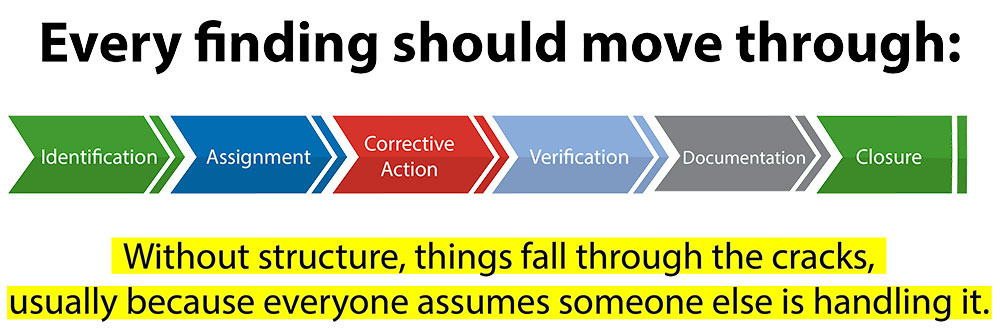
When a QC result falls outside tolerance, don’t just retest until it passes. Dig into what caused it. Could image quality or patient dose be affected? Is it still okay to use the equipment clinically? Does it need service? What corrective action needs to happen, and does it need to get documented? And make sure there’s an actual loop that closes. 

Documentation: You Need To Find It and Know Where It Is…

Imaging departments generate a mountain of compliance paperwork from physics reports, equipment evaluations, QC records, service reports, corrective actions, staff qualifications, continuing ed records, radiation surveys, shielding design docs, equipment registrations, policies, accreditation records. The list is endless.

Having all of it is one thing. Being able to pull it up on demand is another.

Ask yourself four questions:

  • What documentation do we actually need?
  • Where does it live?
  • Who owns it?
  • What’s currently missing or overdue?

If answering four simple questions means digging through emails, spreadsheets, shared drives, and a dozen phone calls, something’s broken.

When a surveyor or inspector shows up, you shouldn’t be scrambling to piece together your own records. You should already know what’s there, where it is, and be ready to prove it.

Accreditation Readiness Isn’t a Seasonal Thing

Whether you’re working toward ACR, IAC, Joint Commission, RadSite, or something else, waiting until renewal season to check your compliance status is just asking for problems to happen.

Readiness should be a year-round state. Missing QC records, unresolved corrective actions, personnel qualification gaps, overdue evaluations can be hard, and sometimes impossible, to fix after the fact.

Instead of asking “are we ready for renewal,” try asking: “could we prove we’re compliant if someone asked today?”

If the answer is yes, all year long, renewal season or announced inspection visits stop being stressful.

Multi-State Systems Have It Even Harder

If you’re running imaging across multiple states, things get more complicated. Everyone wants standardized procedures, and for good reason. It’s more efficient and consistent.

But radiology regulations aren’t standardized. States differ on equipment registration, physics testing frequency, radiation safety rules, corrective action requirements, documentation, and personnel qualifications.

A strong enterprise-wide policy gives you a solid foundation, but it doesn’t guarantee that every facility is meeting its state-specific requirements.

Consistency across sites is valuable, but compliance isn’t one-size-fits-all. What matters is whether each facility is following the requirements that apply to its specific jurisdiction.

That distinction may seem subtle, but it can make a big difference when compliance is on the line.

The Real Cost Is the Disruption

Everyone worries about citations and penalties because they’re easy to point to. But for a Radiology Director, operational disruption is usually the bigger problem.

An unexpected compliance issue can mean emergency testing, rushed equipment service, leadership scrambling, retraining staff, rewriting policies, and building corrective action plans on the fly. If a machine has to come offline, that hits patient care directly with rescheduled appointments, exams shifted to other scanners, technologist schedules thrown off, emergency and inpatient workflows disrupted, and lost outpatient revenue.

At that point, compliance has become an operational crisis, so what started as a compliance gap is now disrupting the whole business.

The Metric You Should Be Working to Improve: How Early Did You Know?

Most organizations measure compliance by whether things got done. Was the physics testing completed? Was QC done? Was the corrective action closed out? Was the accreditation application submitted?

Those matter, yes, but the better questions is: how early did we know there was a problem?

Catching something six months before renewal gives you room to respond carefully and thoughtfully. Catching it six days before creates panic and chaos. Knowing ahead of time that a major repair might require physics testing lets you coordinate service, physics, and scheduling smoothly. Finding out after the equipment’s already back in clinical use? That’s a completely different and much worse situation.

Early visibility is what gives you options.

Move From a Compliance Calendar to a Compliance System

A calendar matters. But a calendar isn’t a program or a system.

Real diagnostic imaging compliance means connecting recurring deadlines with equipment-event triggers, physics testing, QC, regulatory requirements, accreditation standards, corrective action tracking, documentation, and clear ownership, all in one system, not scattered across spreadsheets and inboxes.

Hold your compliance program to the same standard you hold equipment uptime, staffing, throughput, image quality, and patient safety.

  • Where are the handoffs failing? 
  • Which equipment events trigger extra requirements?
  • Are open corrective actions visible to you?
  • Is every facility following the rules for its jurisdiction?
  • And the big one: would your team catch a compliance problem before an inspector or surveyor caught it first?

The best radiology compliance programs aren’t just good at fixing problems. They’re built to find them first.

The good news is you don’t have to navigate it alone. All the complex radiation safety regulations and program challenges become much easier when you have the right health physics team on your side.

If you want to have the most compliant radiology programs you can, our board-certified medical physicists can help you get there.

To learn more about all the compliance services we offer, go to www.westphysics.com

Blog Form Survey Meter Calibration Service
Email(Required)

West Physics Announces Acquisition of Radiographic Testing Services, Inc.

ATLANTA, Sept. 2, 2026 /PRNewswire/ — West Physics Consulting, LLC (“West Physics”), the leading national provider of integrated medical and health physics consulting services, announced today that it has acquired Radiographic Testing Services (“RTS”), an Albany, NY medical physics provider of Nuclear Medicine, Diagnostic Radiology, Radiation Oncology and Certified Radiation Equipment Safety Officer (CRESO) services.

Read the Press Release

New York’s New CBCT Rules Are Here. Is Your Practice Ready?

If your office has a Cone Beam CT scanner, New York just changed the rules on you and one of the biggest deadlines is only weeks away. In this guide you will learn who this affects, what the different requirements are and an explanation of each and a at the end, there is a 5-step checklist on what you can do NOW to make sure you are ready to start the process.

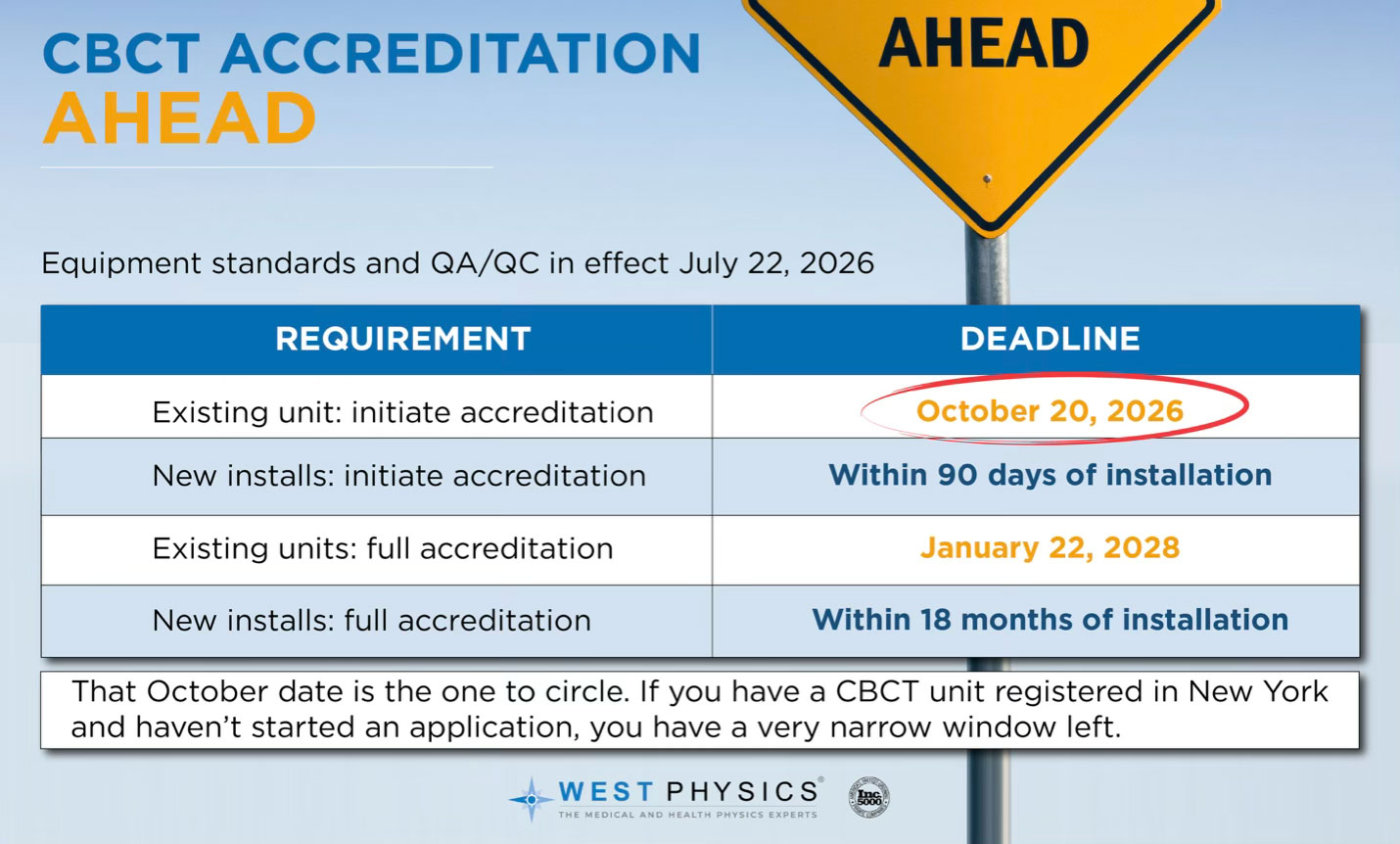
These new New York State requirements took effect on July 22, 2026, and it brings CBCT under a much more strict framework. These include:

  • National accreditation
  • Specific equipment standards and in-service training
  • A written quality assurance (QA) program
  • Patient recordkeeping requirements
  • Daily and weekly quality control testing
  • Initial and Annual physics surveys

This applies to all CBCT units in the state of New York (exceptions noted below), but if you are a dentist placing implants, an ENT scanning sinuses, a podiatrist performing 3D foot imaging, or a chiropractor involved in upper cervical care, this new regulation has significant implications for your practice.

Who This Affects

The new mandate covers any facility operating a diagnostic CBCT unit, regardless of specialty:

  • Dental practices: general dentists, orthodontists, endodontists, periodontists, and oral surgeons using CBCT for implants, TMJ evaluations, or impactions
  • Specialty medical clinics: ENT, orthopedics, sports medicine, podiatry, and chiropractic clinics
  • Imaging centers: outpatient and standalone diagnostic facilities
  • Hospitals: including hospital-based clinics and outpatient departments

The Exemptions

Units used strictly for non-diagnostic purposes are exempt from the accreditation portion of the requirement. Though these exempted units still need to be registered and tested for the state.

The bottom line: if you scan patients diagnostically, you are affected.

What National Accreditation Actually Means

Accreditation is a formal review by a nationally recognized body, such as The Intersocietal Accreditation Commission (IAC) or RadSite. Reviewers at the accrediting body will examine your equipment, your imaging protocols, your staff’s qualifications, your radiation safety practices, and your QA documentation, then decide whether you meet their clinical standards.

The goal of requiring accreditation is threefold:

  • Patient Protection with Lower Dose: Scans should follow the ALARA principle (As Low As Reasonably Achievable).
  • Better Images: Consistent equipment performance means radiologists get high-quality images and they confidently read.
  • Real Consistency: Training, testing, and documentation become routine instead of occasional.

What The Regulation Requires

The new rules layer on top of New York’s existing five-year CRESO inspection cycle, and you can think of them as 3 areas. (Note: This 5-year CRESO inspection only applies to Dentists and Podiatrists. ENT’s, orthopedics, chiropractors, imaging centers and hospitals are not under the CRESO inspection program and are inspected by New York State at various intervals).

1. Equipment Standards

Your CBCT system needs to have:

  • The accreditation process initiated within 90 days of the new regulatory mandate
  • A diagnostic-type protective housing on the x-ray tube
  • Activation controls in a protected area, with the operator required to stay there through the entire exposure
  • Visual and audible indicators showing when x-rays are being produced and when exposure ends
  • Visual contact with the patient (window or mirror) plus a two-way audio
  • A clearly labeled emergency shutoff, with any premature termination requiring a manual reset before the next scan

2. A Written QA Program

You need a QA binder on-site containing:

  • Your New York State registration ID and the unit’s make and model
  • Names of your trained QC staff and your licensed medical physicist
  • The most recent physicist survey, plus maintenance and corrective action records
  • Training documentation. Staff must be trained before scanning patients, then re-trained annually. Training covers basic radiation principles, and is based on your specific machine, and your image viewing system. You must keep records three years, and have the practitioner attest in writing that each employee completed it.
  • Written orders showing exams are only performed when clinically indicated

3. QC Testing. Your Medical Physicist. Your Staff.

Your medical physicist handles:

  • Acceptance testing on new or relocated units
  • Testing after major repairs or upgrades
  • Annual performance surveys
  • Dosimetry calibration with NIST-traceable equipment (calibrated within the past 24 months)
  • Dose Area Product or Air Kerma measurements
  • Adult and pediatric dose evaluation
  • Resolution and noise assessment
  • Scatter measurements within 30 days of installation

Your staff handles:

  • Daily equipment function checks
  • Repeat/reject analysis of patient images
  • Daily CT number verification for bone and water
  • Weekly software and hardware inspections of the viewing system

The Deadlines

And if you fail to obtain accreditation, or lose the accreditation you already had, you must report it to the New York State Department of Health within 30 days.

What Reviewers Look At

Accrediting bodies conduct a peer review of your whole clinical operation:

  1. Equipment performance: baseline acceptance testing and annual survey results
  2. Image quality: clinical images and phantom scans, evaluated for resolution and noise
  3. Radiation dose: evidence that doses are optimized and recorded, with DAP or AK values on consoles and in patient records
  4. Staff qualifications: licensure, credentials, and documented training
  5. Policies and procedures: written protocols for QC, calibration, and clinical indications

Why You Need A Medical Physicist

Practically speaking, accreditation isn’t achievable without one. Many dental and specialty practices are newer CBCT users without a full-time imaging department, and a physics partner fills that gap by handling acceptance testing and radiation surveys, annual performance surveys, QA program development and readiness assessments, like mock reviews that catch problems before a reviewer does.

Where Facilities Get Tripped Up

The failures are predictable, and all of them are 100% preventable:

  • Missing QC logs: Daily and weekly testing wasn’t recorded consistently
  • No written policies: Safety procedures exist in practice but were never documented
  • Incomplete training records: No signed attestations, or no machine-specific training on file
  • Late physics work: A missed annual survey, or scatter measurements not taken within 30 days of installation

Your Five-Step Checklist

  1. Review your QA program: Assemble written procedures, registrant records, and training policies in one place
  2. Confirm your physicist: Make sure a licensed medical physicist is designated in your QA program documentation, and schedule the annual survey
  3. Organize training records: Document initial and annual training, and get the practitioner’s written attestation
  4. Audit your QC logs: Build a daily routine for equipment checks, CT water and bone numbers, and repeat/reject analysis that satisfy the New York CBCT regulations
  5. File your application: Start with IAC or RadSite now. Initiating shows active intent and protects you at the 90-day mark


Don’t Wait

Accreditation isn’t a form you just fill out the week before it’s due. It rests on months of accumulated documentation. Daily logs, training attestations and survey reports that can’t be recreated retroactively or overnight.

The facilities that get through this cleanly are the ones that start early and lean on people who’ve done it before.

Are You Preparing for New York CBCT accreditation? Our board-certified medical physicists help facilities build compliant QA/QC programs, complete the required testing, identify gaps, and get you accreditation-ready. 

Contact us today for a FREE consultation.

Blog Form Survey Meter Calibration Service

Email(Required)