Radiology Compliance: The Real Cost of Waiting Until There’s a Problem
If you manage or work in a radiology department, you already know compliance is far more than passing an inspection or checking boxes. Behind every requirement or regulation is a patient: someone’s parent, spouse, child, or loved one depending on the medical physicist getting it right the first time. Equipment performance, radiation safety, quality control and accreditation ultimately all come down to one thing: provide the highest quality care to patients.
Unfortunately, sometimes compliance can be reactive.
Your annual physics survey is coming up, finally, someone starts to dig through all the records, paperwork, emails and files. Your accreditation renewal is due very soon, so the documentation scramble begins, or a CT tube gets replaced, and only then does someone ask, “so do we need extra testing for this?”. Now a state inspector has shown up, and suddenly everyone’s hunting for paperwork that should’ve been easy to find and quickly accessible
The thing is, by the time you are aware of a compliance issue, you’ve usually already missed your BEST chance to deal with it EASILY.
“Best” and “Easily” being the key words here. If only you would’ve caught it sooner. The shift from reacting to compliance issues to managing them proactively makes all the difference.

The Risk Hides Between The Deadlines
Most departments are great at the predictable and routine stuff. Physics evaluations get scheduled. Registrations get renewed. Accreditation deadlines are on the calendar. Routine QC happens like clockwork.
But the biggest risks often show up between those scheduled events, not during them.
If you think about the normal life of your imaging equipment: a CT tube gets swapped out, a detector fails, a fluoroscopy unit needs a major repair, you move a piece of equipment to a different room, or you renovate the space it’s in, new equipment comes online, software gets upgraded, or a major component gets replaced.
From a day-to-day operations view, these look like routine service events, but from a regulatory view, they can be a whole lot more than that.
Depending on the modality, the specific equipment change, your accreditation requirements, and the state you’re in, any of these events might trigger extra testing, updated registrations, additional surveys, required notifications, or other actions you weren’t necessarily thinking about.
This is exactly where a strong compliance program separate itself from the reactive ones, because a strong compliance program is tracking events, not just dates on a calendar.
Equipment Changes Are Your Biggest Blind Spot
Ask yourself: what actually happens when something changes with your imaging equipment?
When there’s a major repair or a component gets replaced, is there a clear process for figuring out whether that triggers additional testing or regulatory action? That process usually touches several people, like the field service engineer, medical physicist, your Radiation Safety Officer, imaging leadership, and maybe others.
The problem is that these folks often work in totally separate lanes.
The field service engineer knows what parts were replaced. The tech knows when the machine went back into service. The medical physicist understands the testing requirements. The RSO gets the regulatory side for equipment involving the use of radioactive materials. And you, as the leader, are the one on the hook for keeping the department both running and compliant.
So, the risk really lives in the gaps between all of them. If nobody clearly owns that part of the handoff, equipment can go right back into clinical use before anyone has confirmed every compliance box is checked.

Medical Physics Testing Shouldn’t Just Be an Annual Event
Yes, annual medical physics testing is essential. But it shouldn’t be the only time you’re checking on equipment performance.
Medical physics should be integrated throughout the equipment lifecycle, including new installations, relocations, major repairs, tube or detector replacements, acceptance testing, radiation protection surveys and annual evaluations, and then confirming that corrective actions were effective, should all be part of the process.
The specifics change depending on equipment type and jurisdiction, which is exactly why it’s worth knowing ahead of time when physics needs to get involved. The sooner you know, the easier it is to line up testing with equipment downtime and your clinical schedule, instead of scrambling around it.
Letting QC Do Its Job: Catching Problems Early
It’s easy to think of routine QC as just another box to check. But its real value is as an early-warning system.
A solid QC program should flag equipment problems before they turn into image quality issues, dose concerns, accreditation headaches, or full-blown compliance violations.
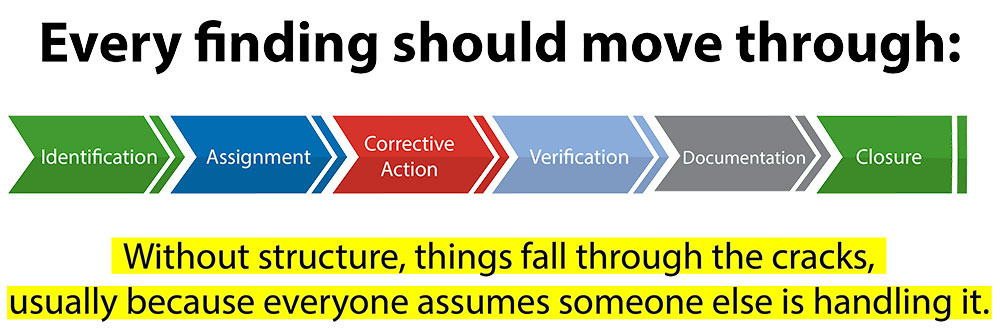
When a QC result falls outside tolerance, don’t just retest until it passes. Dig into what caused it. Could image quality or patient dose be affected? Is it still okay to use the equipment clinically? Does it need service? What corrective action needs to happen, and does it need to get documented? And make sure there’s an actual loop that closes.

Documentation: You Need To Find It and Know Where It Is…
Imaging departments generate a mountain of compliance paperwork from physics reports, equipment evaluations, QC records, service reports, corrective actions, staff qualifications, continuing ed records, radiation surveys, shielding design docs, equipment registrations, policies, accreditation records. The list is endless.
Having all of it is one thing. Being able to pull it up on demand is another.
Ask yourself four questions:
- What documentation do we actually need?
- Where does it live?
- Who owns it?
- What’s currently missing or overdue?
If answering four simple questions means digging through emails, spreadsheets, shared drives, and a dozen phone calls, something’s broken.
When a surveyor or inspector shows up, you shouldn’t be scrambling to piece together your own records. You should already know what’s there, where it is, and be ready to prove it.

Accreditation Readiness Isn’t a Seasonal Thing
Whether you’re working toward ACR, IAC, Joint Commission, RadSite, or something else, waiting until renewal season to check your compliance status is just asking for problems to happen.
Readiness should be a year-round state. Missing QC records, unresolved corrective actions, personnel qualification gaps, overdue evaluations can be hard, and sometimes impossible, to fix after the fact.
Instead of asking “are we ready for renewal,” try asking: “could we prove we’re compliant if someone asked today?”
If the answer is yes, all year long, renewal season or announced inspection visits stop being stressful.
Multi-State Systems Have It Even Harder
If you’re running imaging across multiple states, things get more complicated. Everyone wants standardized procedures, and for good reason. It’s more efficient and consistent.
But radiology regulations aren’t standardized. States differ on equipment registration, physics testing frequency, radiation safety rules, corrective action requirements, documentation, and personnel qualifications.
A strong enterprise-wide policy gives you a solid foundation, but it doesn’t guarantee that every facility is meeting its state-specific requirements.
Consistency across sites is valuable, but compliance isn’t one-size-fits-all. What matters is whether each facility is following the requirements that apply to its specific jurisdiction.
That distinction may seem subtle, but it can make a big difference when compliance is on the line.

The Real Cost Is the Disruption
Everyone worries about citations and penalties because they’re easy to point to. But for a Radiology Director, operational disruption is usually the bigger problem.
An unexpected compliance issue can mean emergency testing, rushed equipment service, leadership scrambling, retraining staff, rewriting policies, and building corrective action plans on the fly. If a machine has to come offline, that hits patient care directly with rescheduled appointments, exams shifted to other scanners, technologist schedules thrown off, emergency and inpatient workflows disrupted, and lost outpatient revenue.
At that point, compliance has become an operational crisis, so what started as a compliance gap is now disrupting the whole business.
The Metric You Should Be Working to Improve: How Early Did You Know?
Most organizations measure compliance by whether things got done. Was the physics testing completed? Was QC done? Was the corrective action closed out? Was the accreditation application submitted?
Those matter, yes, but the better questions is: how early did we know there was a problem?
Catching something six months before renewal gives you room to respond carefully and thoughtfully. Catching it six days before creates panic and chaos. Knowing ahead of time that a major repair might require physics testing lets you coordinate service, physics, and scheduling smoothly. Finding out after the equipment’s already back in clinical use? That’s a completely different and much worse situation.
Early visibility is what gives you options.
Move From a Compliance Calendar to a Compliance System
A calendar matters. But a calendar isn’t a program or a system.
Real diagnostic imaging compliance means connecting recurring deadlines with equipment-event triggers, physics testing, QC, regulatory requirements, accreditation standards, corrective action tracking, documentation, and clear ownership, all in one system, not scattered across spreadsheets and inboxes.
Hold your compliance program to the same standard you hold equipment uptime, staffing, throughput, image quality, and patient safety.
- Where are the handoffs failing?
- Which equipment events trigger extra requirements?
- Are open corrective actions visible to you?
- Is every facility following the rules for its jurisdiction?
- And the big one: would your team catch a compliance problem before an inspector or surveyor caught it first?
The best radiology compliance programs aren’t just good at fixing problems. They’re built to find them first.
The good news is you don’t have to navigate it alone. All the complex radiation safety regulations and program challenges become much easier when you have the right health physics team on your side.
If you want to have the most compliant radiology programs you can, our board-certified medical physicists can help you get there.
To learn more about all the compliance services we offer, go to www.westphysics.com
Blog Form Survey Meter Calibration Service