New York’s New CBCT Rules Are Here. Is Your Practice Ready?

If your office has a Cone Beam CT scanner, New York just changed the rules on you and one of the biggest deadlines is only weeks away. In this guide you will learn who this affects, what the different requirements are and an explanation of each and a at the end, there is a 5-step checklist on what you can do NOW to make sure you are ready to start the process.
These new New York State requirements took effect on July 22, 2026, and it brings CBCT under a much more strict framework. These include:
- National accreditation
- Specific equipment standards and in-service training
- A written quality assurance (QA) program
- Patient recordkeeping requirements
- Daily and weekly quality control testing
- Initial and Annual physics surveys
This applies to all CBCT units in the state of New York (exceptions noted below), but if you are a dentist placing implants, an ENT scanning sinuses, a podiatrist performing 3D foot imaging, or a chiropractor involved in upper cervical care, this new regulation has significant implications for your practice.

Who This Affects
The new mandate covers any facility operating a diagnostic CBCT unit, regardless of specialty:
- Dental practices: general dentists, orthodontists, endodontists, periodontists, and oral surgeons using CBCT for implants, TMJ evaluations, or impactions
- Specialty medical clinics: ENT, orthopedics, sports medicine, podiatry, and chiropractic clinics
- Imaging centers: outpatient and standalone diagnostic facilities
- Hospitals: including hospital-based clinics and outpatient departments
The Exemptions
Units used strictly for non-diagnostic purposes are exempt from the accreditation portion of the requirement. Though these exempted units still need to be registered and tested for the state.
The bottom line: if you scan patients diagnostically, you are affected.
What National Accreditation Actually Means
Accreditation is a formal review by a nationally recognized body, such as The Intersocietal Accreditation Commission (IAC) or RadSite. Reviewers at the accrediting body will examine your equipment, your imaging protocols, your staff’s qualifications, your radiation safety practices, and your QA documentation, then decide whether you meet their clinical standards.
The goal of requiring accreditation is threefold:
- Patient Protection with Lower Dose: Scans should follow the ALARA principle (As Low As Reasonably Achievable).
- Better Images: Consistent equipment performance means radiologists get high-quality images and they confidently read.
- Real Consistency: Training, testing, and documentation become routine instead of occasional.
What The Regulation Requires
The new rules layer on top of New York’s existing five-year CRESO inspection cycle, and you can think of them as 3 areas. (Note: This 5-year CRESO inspection only applies to Dentists and Podiatrists. ENT’s, orthopedics, chiropractors, imaging centers and hospitals are not under the CRESO inspection program and are inspected by New York State at various intervals).
1. Equipment Standards
Your CBCT system needs to have:
- The accreditation process initiated within 90 days of the new regulatory mandate
- A diagnostic-type protective housing on the x-ray tube
- Activation controls in a protected area, with the operator required to stay there through the entire exposure
- Visual and audible indicators showing when x-rays are being produced and when exposure ends
- Visual contact with the patient (window or mirror) plus a two-way audio
- A clearly labeled emergency shutoff, with any premature termination requiring a manual reset before the next scan
2. A Written QA Program
You need a QA binder on-site containing:
- Your New York State registration ID and the unit’s make and model
- Names of your trained QC staff and your licensed medical physicist
- The most recent physicist survey, plus maintenance and corrective action records
- Training documentation. Staff must be trained before scanning patients, then re-trained annually. Training covers basic radiation principles, and is based on your specific machine, and your image viewing system. You must keep records three years, and have the practitioner attest in writing that each employee completed it.
- Written orders showing exams are only performed when clinically indicated
3. QC Testing. Your Medical Physicist. Your Staff.
Your medical physicist handles:
- Acceptance testing on new or relocated units
- Testing after major repairs or upgrades
- Annual performance surveys
- Dosimetry calibration with NIST-traceable equipment (calibrated within the past 24 months)
- Dose Area Product or Air Kerma measurements
- Adult and pediatric dose evaluation
- Resolution and noise assessment
- Scatter measurements within 30 days of installation
Your staff handles:
- Daily equipment function checks
- Repeat/reject analysis of patient images
- Daily CT number verification for bone and water
- Weekly software and hardware inspections of the viewing system
The Deadlines
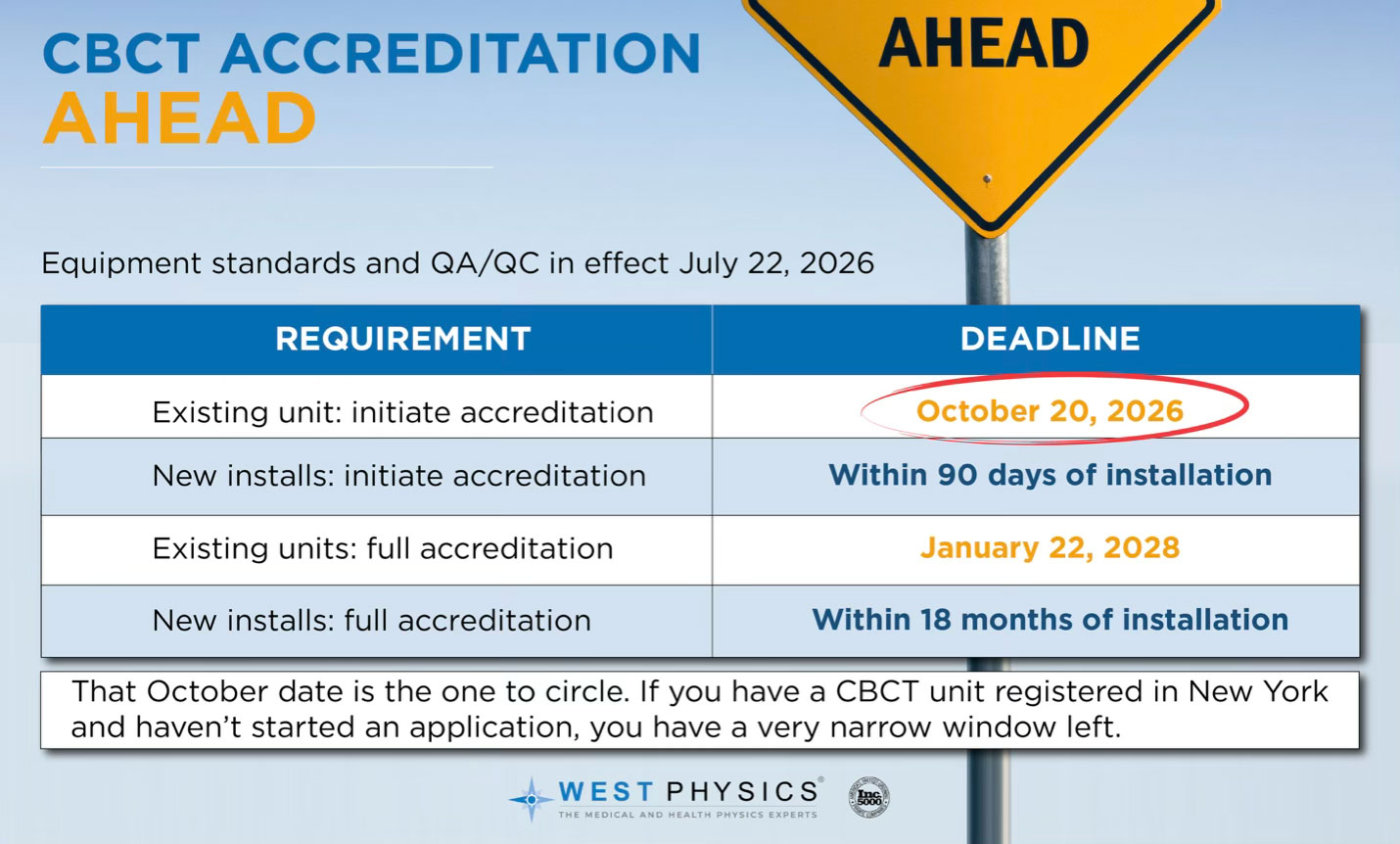
And if you fail to obtain accreditation, or lose the accreditation you already had, you must report it to the New York State Department of Health within 30 days.
What Reviewers Look At
Accrediting bodies conduct a peer review of your whole clinical operation:
- Equipment performance: baseline acceptance testing and annual survey results
- Image quality: clinical images and phantom scans, evaluated for resolution and noise
- Radiation dose: evidence that doses are optimized and recorded, with DAP or AK values on consoles and in patient records
- Staff qualifications: licensure, credentials, and documented training
- Policies and procedures: written protocols for QC, calibration, and clinical indications

Why You Need A Medical Physicist
Practically speaking, accreditation isn’t achievable without one. Many dental and specialty practices are newer CBCT users without a full-time imaging department, and a physics partner fills that gap by handling acceptance testing and radiation surveys, annual performance surveys, QA program development and readiness assessments, like mock reviews that catch problems before a reviewer does.
Where Facilities Get Tripped Up
The failures are predictable, and all of them are 100% preventable:
- Missing QC logs: Daily and weekly testing wasn’t recorded consistently
- No written policies: Safety procedures exist in practice but were never documented
- Incomplete training records: No signed attestations, or no machine-specific training on file
- Late physics work: A missed annual survey, or scatter measurements not taken within 30 days of installation
Your Five-Step Checklist
- Review your QA program: Assemble written procedures, registrant records, and training policies in one place
- Confirm your physicist: Make sure a licensed medical physicist is designated in your QA program documentation, and schedule the annual survey
- Organize training records: Document initial and annual training, and get the practitioner’s written attestation
- Audit your QC logs: Build a daily routine for equipment checks, CT water and bone numbers, and repeat/reject analysis that satisfy the New York CBCT regulations
- File your application: Start with IAC or RadSite now. Initiating shows active intent and protects you at the 90-day mark

Don’t Wait
Accreditation isn’t a form you just fill out the week before it’s due. It rests on months of accumulated documentation. Daily logs, training attestations and survey reports that can’t be recreated retroactively or overnight.
The facilities that get through this cleanly are the ones that start early and lean on people who’ve done it before.
Are You Preparing for New York CBCT accreditation? Our board-certified medical physicists help facilities build compliant QA/QC programs, complete the required testing, identify gaps, and get you accreditation-ready.
Contact us today for a FREE consultation.
Blog Form Survey Meter Calibration Service
