Beyond the Annual Survey: How the Modern Medical Physicist Is Transforming Patient Care
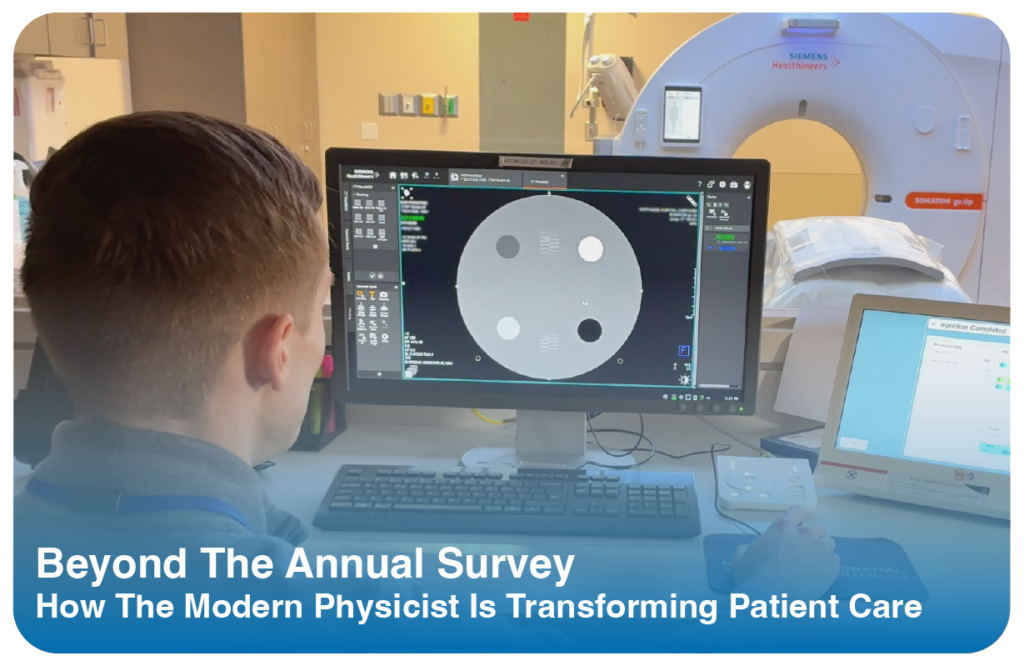
For decades, the medical physicist was often viewed as the behind-the-scenes technical expert. The person who arrived after hours, tested imaging equipment, completed required reports, and moved on to the next facility. Those traditional responsibilities remain essential, but the role of the medical physicist has changed significantly.
Today, medical physicists are increasingly integrated into the clinical environment. They work alongside radiology leaders, radiologists, technologists, IT teams, safety professionals, and other hospital departments to improve imaging quality, optimize radiation dose, strengthen safety programs, evaluate new technology, and support better patient care. As medical imaging has become more complex, the physicist has evolved from primarily a compliance resource into an important clinical partner.

Why the Physicist’s Role Has Changed
Traditionally, diagnostic medical physicists have been responsible for radiation shielding designs, shielding integrity surveys, equipment acceptance testing, periodic physics testing, radiation safety activities, personnel dosimetry, and quality control program oversight.
Those responsibilities have not disappeared, but the scope has expanded.
The growth of advanced imaging technologies such as CT, MRI, PET/CT, and SPECT/CT has introduced new technical and safety considerations. At the same time, increasing imaging volumes, accreditation requirements, regulatory oversight, highly publicized radiation overexposure events, and workforce challenges have pushed medical physicists into a more active role within imaging departments.
The result is a different model of medical physics. One based on collaboration rather than periodic inspection.
Moving From Dose Reduction to Dose Optimization
One of the clearest examples of this expanded role is CT dose optimization.
It can be tempting to think that reducing radiation dose is always the goal. But reducing dose too aggressively can compromise image quality. The real objective is to find the appropriate balance between radiation exposure and the diagnostic information the radiologist needs.
Medical physicists can use phantom testing to evaluate changes in parameters such as kV and mAs and determine how those adjustments affect contrast and noise before changes are introduced clinically. Just as importantly, protocol changes should involve the radiologist so that technical improvements do not come at the expense of diagnostic quality.
Physicists can also help imaging departments make sense of the enormous amount of information generated by dose-tracking systems. A value that appears to be a dose outlier, for example, may actually be the result of how the scanner calculated or reported the dose rather than an actual problem with the examination. For example, a routine head examination can appear as an outlier because a change in scan field of view and bow-tie filter resulted in the dose being reported using a different phantom size.
That distinction can prevent teams from spending time investigating a problem that does not really exist.

Bringing Physics Into Equipment Selection and Facility Design
The physicist’s value can begin long before a new scanner treats its first patient.
When facilities purchase imaging equipment, physicists can help interpret manufacturer specifications, evaluate hardware and software safety features, consider upgrade paths, assess radiation exposure factors, and identify limitations that may not be obvious during the purchasing process.
Their involvement can be equally valuable during construction and room design.
Consider something as simple as the placement of a chest bucky. Putting it against a wall with a highly occupied office on the other side may create unnecessary shielding challenges. In MRI, the location of the control room can affect whether the technologist has a clear view of the entrance to Zone 4. Nuclear medicine and PET departments introduce another consideration: how radioactive material and patients will safely move between hot labs, uptake rooms, and imaging areas.
These decisions demonstrate why physics involvement should occur during planning, not after construction has been completed.

Expanding the Safety Conversation Beyond X-Ray
The modern medical physicist’s safety responsibilities can also extend beyond traditional ionizing radiation.
MRI is one particularly important area. Medical physicists can help establish appropriate MRI zones, evaluate access controls, review signage, measure magnetic field boundaries, assess MR-conditional equipment, and develop policies that protect patients and staff.
The importance of these processes becomes especially clear during an emergency.
MRI safety has become a major focus specifically of Joint Commission surveys, making the medical physicist an important resource for identifying potential risks and strengthening safety programs. Physicists can assess policies and procedures, signage, MRI zone layouts, access controls, the 5-gauss line, and MR-conditional equipment. They can also provide valuable input when designing new MRI spaces, including ensuring technologists have clear visibility and control of Zone 4 access. Regular MRI environment audits and proper documentation help facilities identify issues early, improve clinical workflow, and remain prepared for Joint Commission surveys.
In other words, MRI safety is not simply about having the right sign on the door. It requires a functioning safety system that staff can follow when something goes wrong.
Laser safety is another area where medical physicists can play an important role. Although surgical lasers present different risks than diagnostic X-ray equipment, they still require appropriate policies, training, protective eyewear, equipment inventories, and ongoing safety oversight. Even a seemingly simple oversight can create risk. For example, storing protective eyewear for lasers with different wavelengths together without clear identification can lead staff to select glasses that provide little or no protection for the laser being used.
That is exactly the type of hidden vulnerability a structured physics-led safety program can uncover.

A Clinical Partner, Not Just a Compliance Requirement
Perhaps the biggest change in medical physics is not a new test, regulation, or technology, although those do exist. It is a change in how the physicist fits into the healthcare team.
The physicist increasingly acts as a technical translator, connecting the engineering behind imaging technology with the realities of clinical care. That requires understanding not only how a scanner works, but also how technologists use it, what radiologists need from the resulting images, how patients move through the department, and how technical recommendations affect daily operations.
That perspective can be particularly valuable as imaging departments face increasingly sophisticated technology with fewer available resources.
The days when the physicist simply arrived overnight, tested equipment, and left a report behind are disappearing. Modern medical physics is increasingly built around ongoing collaboration with the staff responsible for imaging operations and patient care.
By involving medical physicists in equipment selection, facility design, dose optimization, accreditation, MRI and laser safety, staff training, and clinical workflow, organizations can move beyond a once-a-year compliance mindset. Medical physics becomes an ongoing part of the safety program, helping imaging teams make informed decisions, strengthen clinical practices, and ultimately support better patient care.
Blog Form Survey Meter Calibration Service